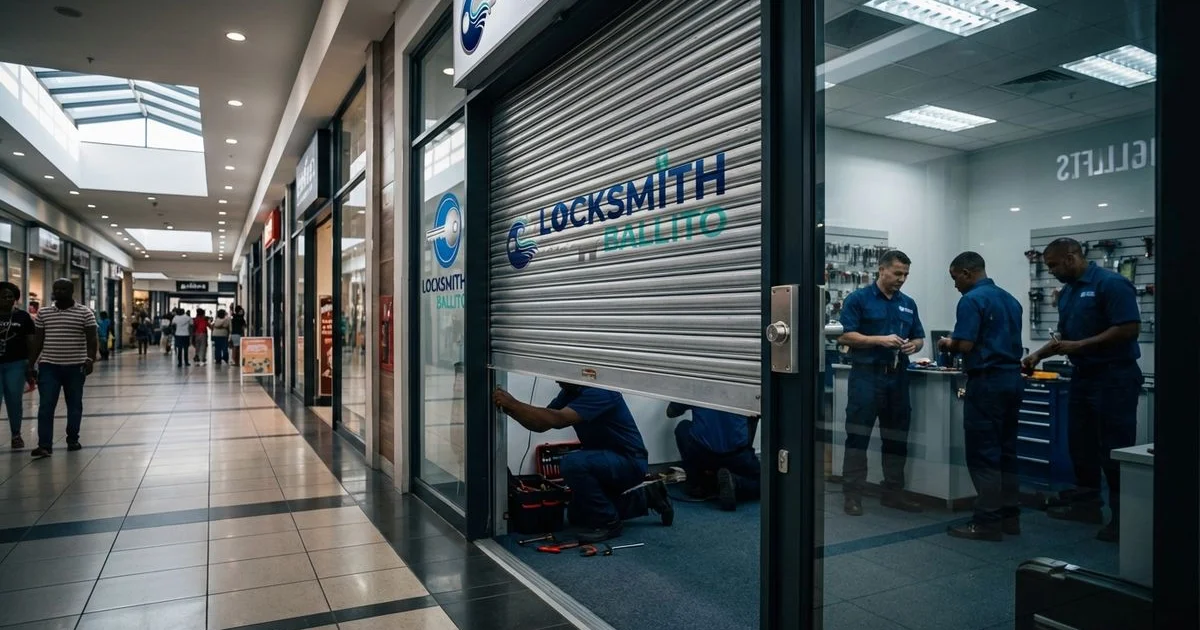
Ballito Junction serves as the commercial anchor of the North Coast. We see it bustle with thousands of shoppers daily, drawn to its mix of boutique retailers and national chains. High foot traffic drives revenue, but it also brings specific security risks like shoplifting and opportunistic break-ins.
Our team has spent years securing commercial spaces across KwaZulu-Natal, including Ballito and the wider Dolphin Coast. The mall provides excellent perimeter control, yet the safety of your specific unit remains your obligation. You need a strategy that handles both external threats and internal shrinkage.
Here is exactly how to secure your Ballito Junction retail unit effectively.
Start with the Doors
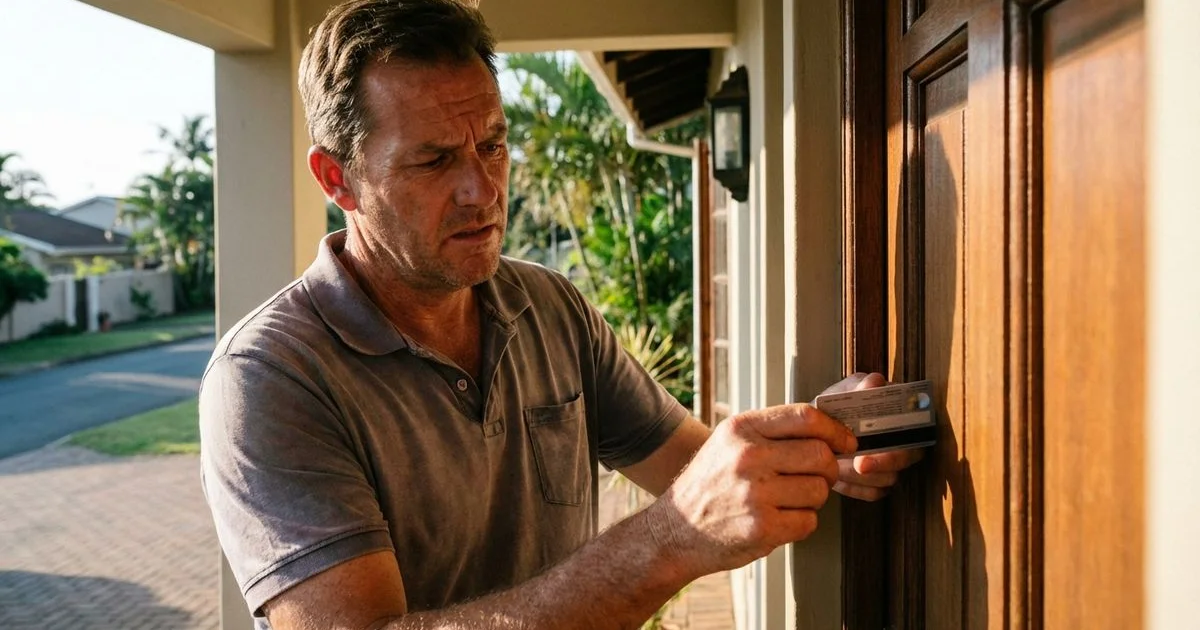
Your front and back doors are the primary barriers against forced entry. We find that stock-standard locks on these doors often fail to stop determined criminals for more than a few seconds.
Front Entrance
Most retail units in the centre feature glass shopfronts with aluminium-framed doors. These typically come with a standard “euro-profile” cylinder lock. While functional for basic privacy, these standard cylinders are vulnerable to “lock snapping,” a common technique used by burglars in South Africa.
Upgrades to consider:
- Anti-Snap Cylinders: Choose brands like Cisa or Assa Abloy that have a sacrificial cut. If a thief tries to snap the lock, only the tip breaks off, leaving the mechanism secure.
- Hook Bolts: Replace standard swing bolts with hook bolts for sliding doors. These hook into the frame and prevent the door from being lifted off its track.
- Armoured Escutcheons: Install a metal ring around the cylinder. This simple addition prevents pliers or wrenches from gripping the lock barrel.
- Floor Bolts: Add a drop bolt at the base of double doors. It creates a third locking point that makes forcing the doors inward significantly harder.
Back Door and Service Entrance
The service corridor is often where the real risk lies. These areas are low-traffic zones, giving criminals more time to work on a lock without being seen. We often see solid fire doors secured with cheap, builder-grade hardware that offers little resistance.
Essential upgrades:
- Commercial Deadbolts: Install a deadbolt with a minimum 25mm throw.
- Hydraulic Door Closers: Adjust these seasonally. A closer that is too loose can leave the door slightly ajar, which bypasses the lock entirely.
- Spy Holes: Install a wide-angle viewer. Staff must be able to visually identify delivery personnel before unlocking the door.
- Hinge Bolts (Dog Bolts): Fit these steel pins into the hinge side of the door frame. If a burglar cuts the hinges from the outside, the door stays locked in the frame.
Always check your lease agreement before making any physical modifications to your unit. Most commercial leases at Ballito Junction permit security upgrades but may require landlord approval for structural changes.
Roller Shutters and Security Gates
Physical barriers are your most visible deterrent. We recommend creating a visual impression of difficulty that convinces criminals to move to an easier target.
Roller Shutters
- Lock Mechanisms: Inspect the centre lock housing. If it is made of plastic or thin pot metal, replace it with a welded steel housing.
- Guide Rail Tolerance: Check the movement of the shutter in the rails. If there is more than 5mm of play, the shutter can be levered out of the track.
- Motor Disconnect: Secure the manual override box. Criminals often pick the box lock to access the manual crank and simply wind the shutter up.
- Bottom Bar Reinforcement: Add a “bullet lock” or “ground lock” to the bottom bar for specific high-risk periods like the December holidays.
Security Trellis Gates
Internal trellis gates, often called slam-locks, act as the final line of defence. They are vital for stores with glass fronts, as glass can be smashed in seconds.
Comparison: Roller Shutter vs. Trellis Gate
| Feature | Roller Shutter | Trellis Gate (Slam-Lock) |
|---|---|---|
| Visibility | Blocks view completely (solid) | Allows police/guards to see inside |
| Airflow | None | Good airflow for HVAC efficiency |
| Attack Resistance | High (if maintained) | Medium to High (brand dependent) |
| Space Required | Requires bulky overhead box | Retracts into a compact side stack |
Cash and Stock Security
Locks keep people out, but internal controls keep money safe. We consistently advise clients that internal shrinkage often costs more than external theft.
Install a SABS-Rated Safe
A generic metal box is not a safe. You need a unit that carries a specific SABS rating relative to the amount of cash you hold. Our safe opening specialists can also help if you lose access to an existing safe. Insurance companies in South Africa often reject claims if the cash held exceeded the safe’s rating.
Safe ratings to look for:
- Category 1: Typically covers cash up to R5,000.
- Category 2: typically covers cash up to R12,500.
- Category 2 ADM: typically covers cash up to R50,000.
- Digital Drop Safes: Use these for skimming till cash throughout the day. Staff can deposit notes without having the ability to open the safe.
Cash Handling Procedures
- Vary Routines: Change your banking times and the route you walk to the car. Predictability is a security risk.
- Two-Person Rule: Ensure two staff members are present during opening and closing procedures.
- Limit Till Floats: Keep till levels low. Clear excess cash to the drop safe immediately when it hits a set limit, such as R2,000.
- Counterfeit Detection: Equip cashiers with UV lights or marker pens to check high-denomination notes (R100 and R200).
Stock Security
- Zoning: Separate the stockroom from the sales floor with a locked door. Only authorized staff should enter.
- Receiving Protocols: Check deliveries immediately against the invoice in the presence of the driver. Shortages often happen during the “handover” chaos.
- EAS Tagging: Use electronic article surveillance tags on high-risk items. The visual presence of the tag is often enough to deter casual shoplifters.
Key Management
We find that lost or unreturned keys are a massive, hidden security gap for retailers. If a manager leaves and fails to return a key, your entire store is technically compromised until you change the locks.
Key Control Best Practices
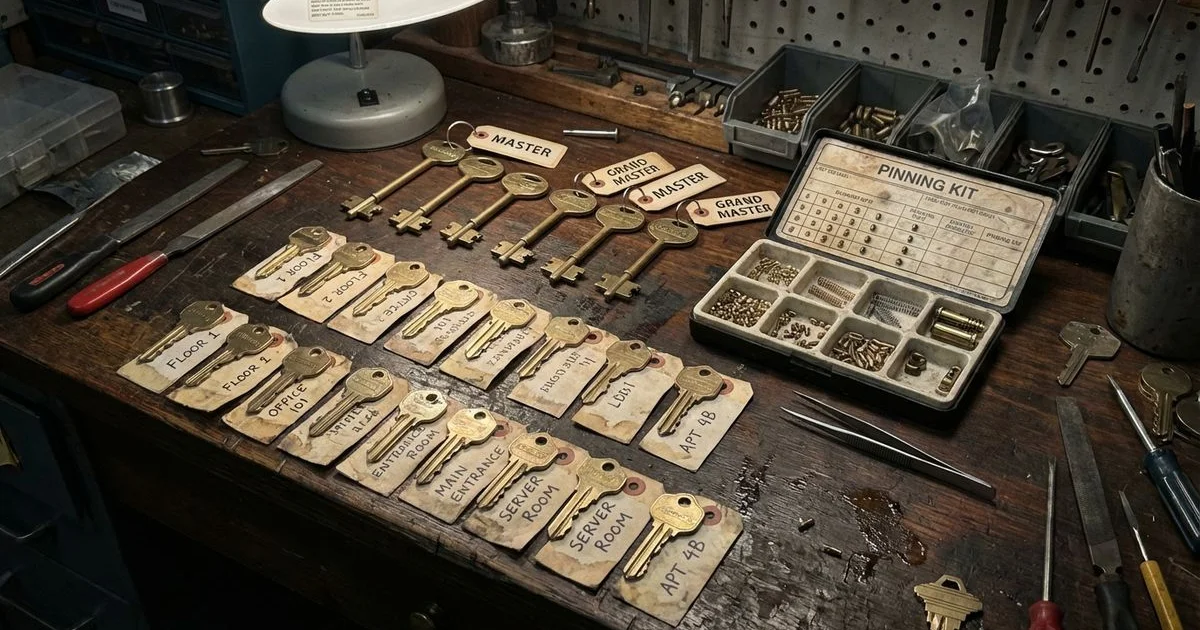
- Implement a Master Key System (MKS): This allows you to open every door with one key, while staff keys only open specific areas (e.g., the front door but not the office).
- Use Patented Keyways: Install cylinders that use restricted keys. These keys cannot be cut at a standard kiosk in the mall; they require a letter of authority and must be cut by a specific locksmith.
- Conduct Key Audits: Check who has which key every quarter. Update your register immediately if keys change hands.
- Tag Keys with Codes Only: Never attach a tag that says “Store Name” or “Back Door.” Use a random colour code or number system that only you understand.
A restricted keyway system costs slightly more upfront but prevents unauthorised key duplication. Keys can only be copied by presenting a security card to an authorised locksmith — giving you complete control over who has access.
Alarm Systems and Load Shedding
Mall security handles common areas, but your unit needs independent monitoring. The frequent power outages in South Africa make battery backup the most critical feature of any modern alarm system.
Recommended Features
- Dual-Path Communication: Ensure your alarm transmits via both GPRS (mobile data) and IP (internet). If one goes down, the other takes over.
- Load Shedding Power Packs: Standard alarm batteries last 4-6 hours. We recommend upgrading to an external power supply with a Lithium Iron Phosphate (LiFePO4) battery, which can last 12-24 hours.
- Partitioning: Set up the alarm so you can arm the back office while staff are working in the front. This protects personal belongings and cash reserves during trading hours.
- App Integration: Choose systems like Paradox or Ajax that allow you to arm/disarm and view status directly from your smartphone.
Monitoring Options
- Self-Monitored: You get the notification on your phone. This is cheaper but requires you to answer the phone at 2 AM.
- Armed Response Link: Link your alarm to a local provider. The rapid response time is worth the monthly subscription.
CCTV and POPIA Compliance
Cameras are essential for evidence and deterrence. Modern IP systems offer high definition clarity that analog systems simply cannot match.
Camera Placement Priorities
- The Transaction Zone: Place a high-resolution camera directly above the till. It must be clear enough to read the denomination of a note.
- Eye-Level Entrance Cams: Ceiling cameras often just capture the top of a head (or a hoodie/hat). Install a camera at eye level near the door to capture facial features.
- Delivery Bay: Cover the entire receiving area to resolve disputes with suppliers about short deliveries.
- Blind Spots: Identify aisles hidden from the counter view and cover them.
Legal Considerations (POPIA)
South Africa’s Protection of Personal Information Act (POPIA) impacts how you use CCTV.
- Signage is Mandatory: You must display clear signs stating that the premises are under CCTV surveillance.
- Data Security: The recorder (NVR) must be in a lockable cabinet. If footage is stolen or leaked, you could be liable for a data breach.
- Retention Policy: Don’t keep footage forever. Configure your system to overwrite data automatically after 30 days unless it is needed for an investigation.
After-Hours Security Checklist
Our team uses this simple closing protocol to ensure nothing is missed. Print this out and place it near your keypad.
- Cash is cleared from tills and deposited in the drop safe.
- Drop safe is locked and the key is removed from the premises.
- Back door deadbolt is engaged and the door is physically pushed to test security.
- All windows and high-level vents are closed.
- Delivery cage or stockroom is locked.
- Roller shutter is fully down and locked (test the lift).
- Alarm is armed and the “armed” light is solid.
- Security gate is locked.
Protect Your Investment
We know that securing a retail unit requires more than just a strong lock. It demands a layered approach that combines physical hardware, electronic intelligence, and disciplined staff procedures. Each layer you add makes your store a less attractive target for criminals.
A commercial locksmith can audit your current security setup and recommend cost-effective upgrades tailored to your specific unit and risk profile.