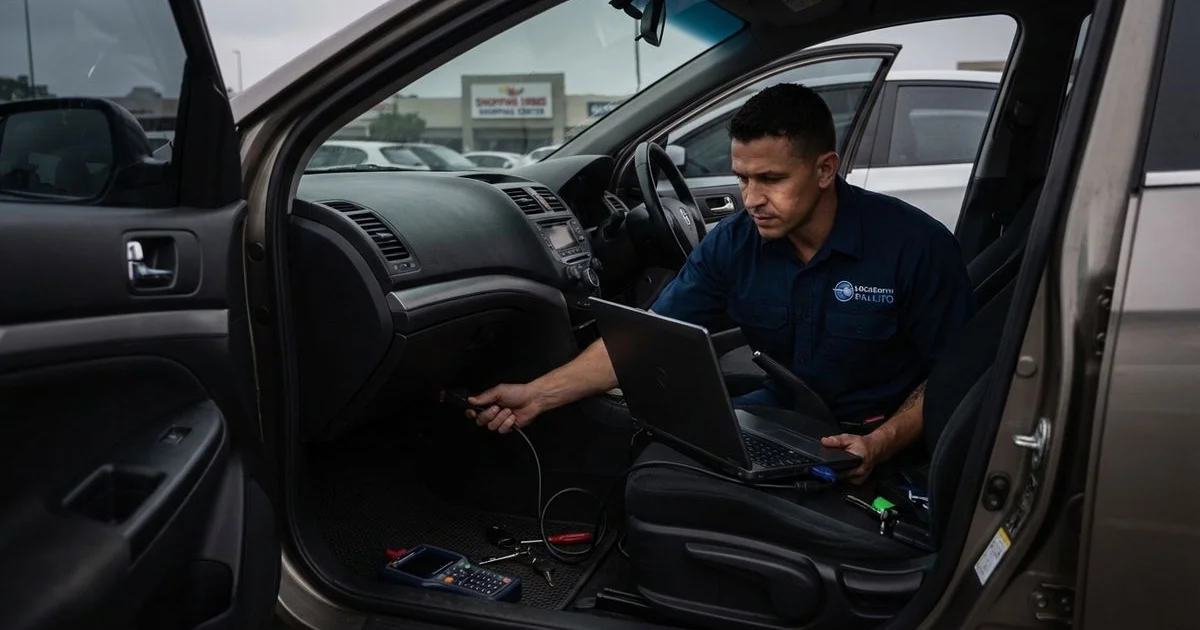
You check the quote for a replacement car key and blink twice at the total.
It is a common reaction.
We see this surprise on customers’ faces almost every day.
Drivers remember the days when a spare key cost the same as a lunch.
Our team understands that the price jump feels unjustified compared to the simple metal keys of the past.
Modern vehicle security has transformed the humble key into a sophisticated computer component.
We are going to break down exactly what you are paying for and why it is actually good news for your car’s safety.
Let’s look at the technology, the real costs involved, and the smartest way to handle auto key replacement.
What Is a Transponder Key?
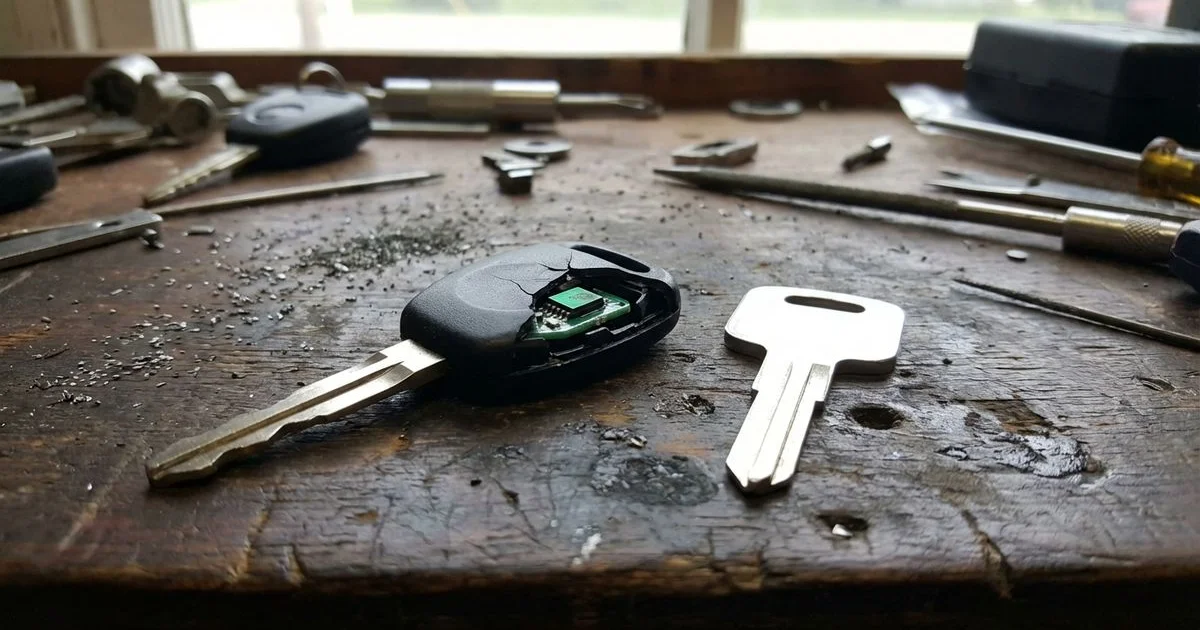
A transponder key is a high-tech security device disguised as a standard car key.
We often explain it to clients as a two-part system: the metal blade turns the lock, but the invisible chip disarms the engine.
Inside the plastic head of your key sits a microchip containing a unique serial number.
This chip uses Radio Frequency Identification (RFID) to communicate with your car.
When you insert the key or push the start button, an induction coil around your ignition sends out a burst of energy.
The chip catches this energy and replies with its unique alphanumeric code.
If the car’s Engine Control Unit (ECU) recognizes the code, the immobilizer turns off.
The engine roars to life.
If the car does not get a response, or if the code is wrong, the fuel pump and ignition system remain dead.
You can turn the engine over until the battery dies, but the car will simply not start.
A Brief History of Anti-Theft Tech
Car theft was an epidemic in the early 1990s.
Thieves could hotwire a vehicle or use a “jiggle key” to bypass the ignition in seconds.
We saw manufacturers respond by introducing the first mandatory immobilizer systems around 1995.
This shift made hotwiring practically impossible for the average criminal.
In South Africa, this technology is not just a feature; it is a necessity for insurance compliance.
Most major insurers now require a VESA-approved immobilizer system, which is standard in almost every vehicle sold after 2000.
Your transponder key is the primary reason modern cars are so difficult to steal without the original keys.
Types of Transponder Keys
Not all chips are created equal.
We encounter three main categories of key technology in the field, ranging from basic to highly encrypted.
1. Fixed-Code Transponders (The Older Generation)
These keys send the exact same password to the car every time you start it.
Our technicians see these mostly in older models, such as early 2000s Toyota Tazz or Citi Golfs.
While better than nothing, they are vulnerable because a thief can copy that single code onto a blank chip.
2. Rolling-Code “Crypto” Transponders
Manufacturers upgraded to “crypto” chips to stop code cloning.
These systems change the password every single time you start the car.
The key and the car’s computer share a secret mathematical formula.
They both calculate what the next code should be.
If a thief intercepts the signal today, it is useless tomorrow because the code has already rolled over.
Most modern vehicles on South African roads, including the VW Polo and Ford Ranger, use this rolling-code technology.
3. Smart Keys and Proximity Fobs
The newest systems remove the mechanical key blade from the equation entirely.
We refer to these as “Keyless Go” or proximity systems.
You keep the fob in your pocket or bag.
Antennas inside the car detect the fob’s encrypted signal as you approach.
This offers convenience, but the technology inside these fobs is significantly more expensive to manufacture and program.
Why Do Transponder Keys Cost More?
The price tag on a modern key reflects four distinct cost factors.
We want to show you exactly where your money goes during a replacement.
The Microchip Hardware
The head of your key contains a miniature circuit board, an antenna, and a processor.
This is not just molded plastic; it is precision electronics.
High-security chips for luxury brands like BMW or Mercedes-Benz use proprietary technology that costs significantly more to source than a standard ID46 chip found in a Hyundai.
Licensing and “Token” Fees
Many people do not realize that locksmiths often pay a fee every time we program a key.
We call these “token fees.”
Vehicle manufacturers license their software to diagnostic tool companies.
To access the server that calculates your car’s security code, we often have to pay a per-use fee to the software provider.
That cost is built into the price of the key.
Specialized Diagnostic Equipment
Programming a key requires an OBD2 computer that interfaces with your car’s brain.
Our equipment inventory includes programmers that cost upwards of R50,000 each, plus annual software subscriptions.
This gear must be updated constantly to talk to the latest 2025 and 2026 vehicle models.
Without this investment, we could not communicate with your car’s security system.
The Risk of the “All Keys Lost” Scenario
If you have lost your only key, the workload doubles or triples.
We cannot simply copy data from an existing key.
The technician must often extract the dashboard or the ECU to read the security data directly from the memory chip on the circuit board.
This is a delicate surgical procedure for your car.
It requires higher expertise and takes much longer, which naturally increases the labor cost.
Did you know? A transponder chip does not usually require a battery to start the car. If your remote battery dies, you can still start the engine by holding the fob against the start button or using the emergency blade. The chip is powered by the magnetic field from the ignition coil.
Transponder Key vs. Regular Key: 2026 Cost Comparison
Price variances depend heavily on the vehicle brand and the complexity of the encryption.
We have compiled a typical pricing guide for the South African market to help you budget.
| Service Type | Typical Cost (Independent Locksmith) | Time Required |
|---|---|---|
| Standard Metal Key (Old school, no chip) | R80 - R180 | 5-10 minutes |
| Transponder Key (Chip only, no buttons) | R850 - R1,600 | 20-40 minutes |
| Remote Key (Integrated buttons & chip) | R1,800 - R3,500 | 30-60 minutes |
| Smart Proximity Fob (Push-to-start) | R3,500 - R8,000+ | 1-2 hours |
| ”All Keys Lost” Service (Origination) | R4,500 - R12,000+ | 2-4 hours |
What Drives the Price Up?
Certain factors will push your quote toward the higher end of the spectrum.
We analyze these variables before giving you a final price:
- Luxury Brands: German and Italian vehicles often require more expensive OEM keys.
- Active Alarms: If the alarm is screaming, we have to silence it before programming can begin.
- Locked ECUs: Some modern ECUs are “locked” by the dealer, requiring bench work to unlock them.
- Location: Emergency call-outs to the side of the N2 highway across Ballito and the Dolphin Coast carry different costs than a scheduled driveway appointment.
The Critical Importance of a Spare
Waiting until you lose your last key is the most expensive mistake a car owner can make.
We cannot stress this enough: duplication is cheap; origination is expensive.
When you have one working key, we can “mirror” the data to a new one in minutes.
If you lose that last key, the car effectively assumes it is being stolen.
The computer shuts down, and we have to perform a complete system reset or ECU flash to get you back on the road.
Pro Tip: If you only have one key, stop reading and book a duplication service immediately. You will save roughly 50% to 70% compared to the cost of replacing a lost key later.
Locksmith vs. Dealership: Who Should You Choose?
Vehicle owners often default to calling the dealership for a car key replacement.
This is rarely the most efficient option.
We operate as mobile units, meaning the workshop comes to your location.
Dealerships typically require you to tow the vehicle to their floor.
They often have to order the key from their international headquarters, which can take 7 to 21 working days to arrive.
Our vans carry universal and OEM-quality stock that we can cut and program on-site, usually within an hour of arrival.
The technology is identical, but the convenience and speed are vastly different.
Final Thoughts
The cost of a transponder key pays for the advanced security that keeps your car in your driveway.
We know it feels like a grudge purchase, but it is a vital protection against theft.
Our advice is simple: value your keys like you value your wallet.
Check that you have a backup today.
If you are down to your last key, getting a spare made now is the smartest financial decision you can make for your vehicle.